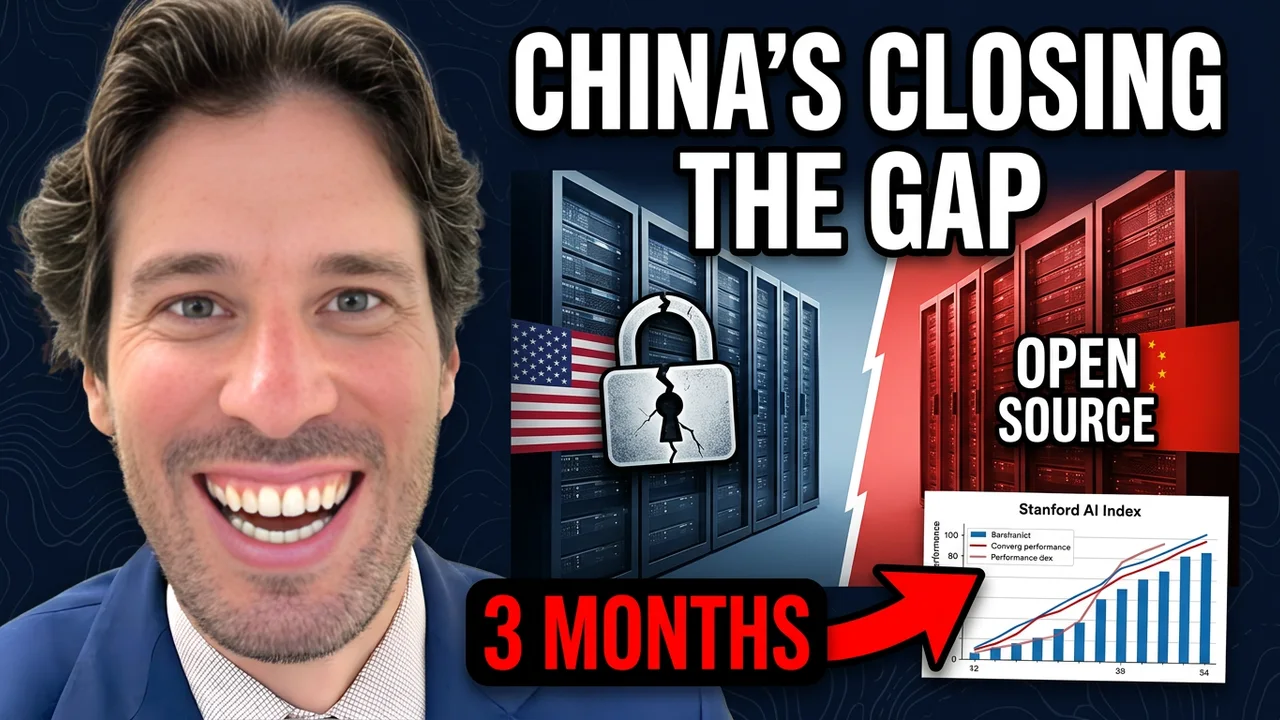
China's open-weight AI has closed the capability gap with the United States from roughly 12 months to about 3 months over the past two years — my analyst-derived estimate, drawn from directional trends in the Stanford AI Index and Epoch AI benchmarking data, not a figure either source publishes directly. At a three-month lag, the same Epoch AI and LMArena benchmark data shows the leading Chinese open-weight models scoring within a few points of US closed-source systems on the STEM and coding evaluations enterprise buyers actually use — close enough that the gap rarely decides a procurement on capability alone — and that proximity changes the adoption calculus entirely.
How does China's shrinking AI lag affect enterprise adoption?
Chinese open-weight models have closed the performance gap with US closed-source systems from roughly 12 months down to about 3 months — my analyst-derived estimate, drawn from directional trends in the Stanford AI Index and Epoch AI, not a figure either source publishes directly. What those sources do show is that Chinese models are now competitive on the STEM and programming benchmarks that enterprise buyers actually use to evaluate models.
When the lag is that narrow, price becomes the primary differentiator. That shift changes the adoption decision in ways the current US market strategy doesn't fully account for. I wrote about why cost has become the deciding factor in model choice separately — the short version is that flat-rate pricing collapsed under token volume pressure, and now every enterprise CFO is looking at per-token spend with fresh eyes.
Why does the US AI strategy prioritize compute scaling over open-weight models?
Open-weight models are AI models whose training weights are publicly released, allowing anyone to download, fine-tune, and deploy them. My read of the US strategy is that it's a wager on closed-source, multimodal systems built on proprietary training pipelines — the thesis being that sheer compute creates a moat open-weight competitors can't cross.
That moat is shrinking by the quarter. If the lag was 12 months two years ago, then 6, then 3 — by my analyst-derived estimate from those benchmarking trends — the extrapolation is uncomfortable. At some point the gap becomes noise, and compute cost is the only differentiator left.
What did the US-China AI summit reveal about China's negotiating position?
Reading the summit sequence — a reported Boeing aircraft deal whose figures I couldn't independently verify, Jensen Huang's restaurant appearance — one read stands out. The US came to negotiate access and left without a deal.
You might also like




China signaled that its unreleased models are already competitive enough that it has no need to open its market to US AI systems. China held the stronger negotiating hand. The Trump frontier AI executive order was partly a policy response to exactly this dynamic — an attempt to shore up US positioning before the gap closes further.
How does the AI cost gap between US and Chinese models reshape adoption decisions?
My view is that the cost gap is already splitting the market by segment. Routine, high-volume, low-complexity tasks don't require frontier closed-source models — open-weight alternatives are good enough there.
Individual builders on tight budgets and mid-tier companies running templated workflows will route that work to whatever runs cheapest. As open-weight models close the quality gap, the CFO's incentive to defect on routine work accelerates.
Will enterprise companies stay on US closed-source AI or switch to cheaper alternatives?
My expectation is that top enterprise companies in law, healthcare, and finance won't defect on cost. A wrong inference in a clinical or legal context is not a recoverable error, and the risk calculus doesn't change with cheaper pricing.
The financial incentive to stay on closed-source is strong precisely because being second-tier in those domains carries real consequences. Open-weight and Chinese models take the high-volume, low-stakes work; closed-source holds the rest.
| Use case | Likely model choice |
|---|---|
| Complex legal or financial reasoning | Closed-source (Claude, GPT-4 class) |
| Healthcare inference and clinical support | Closed-source |
| Routine CRM tasks, templated emails | Open-weight or Chinese models |
| Mid-tier company general productivity | Hybrid or open-weight |
| Individual builders on tight budgets | Open-weight |
Could a compute architecture breakthrough disrupt the US-China AI scaling race?
I hold this loosely. The expectation is that someone eventually invents a genuine architectural shift that sidesteps the raw-compute requirement entirely. Not an incremental chip improvement, but a fundamental rethink that makes the current scaling war look like a local maximum.
Entrenched data center interests have strong financial incentives to delay that shift. If it comes, the closed-versus-open argument gets reframed entirely. China's efficiency and domestic chip strategy already points in this direction — they've been forced by export controls to optimize their way around the compute ceiling rather than scale through it.
Frequently asked questions about the US-China AI divide
That routing logic, not a wholesale switch, is what I expect to see as the dominant enterprise outcome.
Does the geopolitical chip ban change the long-term AI balance? The export controls on advanced chips add real friction today. According to China's own claims — which I haven't been able to independently verify — chip manufacturing capability is approaching Nvidia's level. I went deeper on China's chip and efficiency strategy in China's AI Reckoning, which covers how domestic chip investment and algorithmic efficiency are being used in tandem to offset the hardware ceiling.
If that claim holds, the ban becomes less of a ceiling on Chinese AI development than currently assumed. Whether it remains a binding constraint in three years is the open question.
How quickly is China's AI capability gap closing? By my analyst-derived estimate — drawn from directional trends in the Stanford AI Index and Epoch AI, not a figure either publishes directly — the gap has compressed from roughly 12 months to about 3 months over the past two years. That's roughly a quarter of the lag eliminated per year. If the pace holds, the gap could become statistically negligible within the next year or two on the benchmarks that matter most to enterprise buyers. Whether it holds is the question — the US is not standing still, and closed-source labs are still pushing the frontier. But the directional trend is clear: the gap is closing faster than US market strategy has fully priced in.
What should enterprises do now to prepare for a two-tier AI market? My practical read is that enterprises should map their AI workloads by error tolerance and token volume — two axes that determine where the economics favor switching. High-stakes, low-volume inference (legal review, clinical decision support, complex financial modeling) stays on closed-source; the cost differential doesn't justify the risk. High-volume, moderate-stakes work (code generation, document summarization, customer support drafts, templated communications) is where open-weight alternatives are already cost-competitive and closing on quality. Starting that segmentation now — before a vendor repricing event or a capability parity announcement forces the decision — gives procurement and engineering teams time to evaluate alternatives without urgency. The worst outcome is being caught flat-footed when the gap closes further and the CFO asks why you're still routing routine work through the most expensive option.
What does the AI competition mean for software developers specifically? Software development is one of the benchmark categories where Chinese open-weight models are most directly competitive by my read of the trends. Code generation, debugging assistance, documentation, and test writing are all well-defined, structured tasks where the performance gap between open-weight and closed-source has narrowed significantly. For individual developers and small teams, the cost difference between self-hosting a capable open-weight model and paying for a premium API subscription is already large enough to drive decisions. For enterprise engineering organizations, the calculus is about risk tolerance: a misgenerated SQL query in a production codebase is a real incident, and not all teams have the review layers to catch it. My expectation is that developer tooling will segment by team size and risk posture — large engineering orgs with mature review cultures route more work to cheaper models; smaller teams without that safety net stay on premium closed-source longer.
Where can I read more about the US-China AI divide on iCharles?
- China's AI Reckoning: Efficiency, Domestic Chips & the Real State of the Race — a deeper look at China's chip strategy and efficiency gains.
- The Economics of Token Exhaustion: Why Flat-Rate AI Subscriptions Collapsed — why cost, not capability, is becoming the deciding factor in model choice.
- The 30-Day Head Start: Trump's Frontier AI Executive Order — how US policy is responding to the closing capability gap.



0 Comments
Log in to comment
Not a member yet? Join the community
Pick a meme
KlipyHave a great take?
Drop your email — we'll send a magic link so you can post it. No password.
Not a member of the community? Join today.
Join the community →